Fitness And Sports Training
  • Home
  • Triathlon Coaching
  • Performance Training
  • Contact
  • Personal Training
  • Men's Strength Training
  • Women's Strength Training
  • FAST Pictures
  • FAST Blog
  • Home
  • Triathlon Coaching
  • Performance Training
  • Contact
  • Personal Training
  • Men's Strength Training
  • Women's Strength Training
  • FAST Pictures
  • FAST Blog
Search

FAST Blogs

Consistent Restorative Sleep!

8/25/2025

0 Comments

 
​   Hello and welcome back to my blog. It is my goal to provide you with common sense information based on good science and my personal experience.
   Sleep – Remember when you were 10 years old? Lights out and so were you, for 8-10 hours of uninterrupted sleep. You woke up refreshed; no headache, brain fog or soreness. Most middle aged and older adults would shell out the equivalent of a car payment each month to have that sleep back.
Is it possible to regain that quality sleep? It’s difficult, however there are ways to wake up a whole lot more refreshed. Following are tips:
  1. Manage Caffeine Intake:
   A cup of coffee (based on 8 oz.) has anywhere from 95-200 mg of caffeine, depending on brewing methods and roast type. Some Energy drinks (not sports drinks like Gatorade) and pre-workout supplements have 300- 400 mg of caffeine in a 16 oz bottle or scoop of powder. The most caffeine an adult should have in a day is 400 mg.
The half-life or how long you feel ½ the effects of caffeine is typically six hours, however in some individuals effects are felt up to 12 hours. (VeryWellHealth.com) As a result that mid afternoon cup of coffee or pre workout supplement could be affecting your ability to fall asleep or stay that way. Try eliminating intake after 12:00 noon and cutting back on volume. Two 16 oz. cups or mugs is four servings not two.


     2. Manage Screen Time:
After sunset, light throws the body's biological clock—the circadian rhythm—out of whack. Sleep suffers. Of all the colors blue wavelengths are the most disruptive. The proliferation of electronics with screens, is increasing our exposure to blue wavelengths, especially after sundown. (Harvard Health Publishing) Take control by:
  • Avoiding looking at bright screens beginning two to three hours before bed
  • If you work a night shift or use a lot of electronic devices at night, consider wearing blue-blocking glasses or installing an app that filters the blue/green wavelength at night.
​
      3. Establish Bedtime Patterns:
   A daily bedtime routine is a series of activities you do in the half hour to an hour before bedtime.
   (The Sleep Foundation.org)
 Try the following:
  • Decide on a bedtime and wake-up time that are most conducive to your schedule and stick to them every day, including on weekends.
  • Schedule a time to begin your bedtime routine every night, anywhere between 30 minutes to 2 hours before bed. Set a reminder alarm if needed.
  • Avoid alcohol which may help you fall asleep but results in your waking several hours later. Alcohol is a diuretic which means if you’re already getting up to pee you’ll now be getting up more.
  • Make your bedroom as cool and dark as possible.
Read a book vs. watching TV. TV is for the living room and the bedroom is for sleeping and adult activities.​​

     4. Exercise:
   Exercising, outside in natural light and fresh air will greatly enhance your ability to fall asleep quickly and stay that way. Remember the last time you did yard work or played on the beach all day? Chances are you slept well.

   Am I telling what you already know? If so, your job is to act on the areas above that are impairing you’re sleep and ultimately your reaching rewarding goals. Write down a plan and stick to it!
  
​    Need someone to design an exercise program that results in sound sleep?
   [email protected]


0 Comments

Strength Training - How To

8/13/2025

0 Comments

 
   Strength. How much you need is based on your lifestyle. City dweller with a tech job living in an apartment – not much. Rancher setting railroad tie corner posts and throwing calves- much. Regardless of lifestyle, strength is important to support healthy movement and allow us to perform activities of daily living without undo strain or injury.
   Additional reasons you might choose to include 2-3 strength sessions in your busy week:​
  • Pulling and pushing against resistance puts a strain on your bones. The result; osteoblasts are sent to build more bone and thus a reduced risk of osteoporosis.
  • Harvard Health estimates a 155 pound person will burn 430 calories in an hour of vigorous strength training.  Twice a week is 860 calories. Add to that, excess post-exercise oxygen consumption ( calories burned to return your oxygen levels, HR, body temperature, hormone and blood sugar levels to normal) and you could lose 1/3 –1/2  a pound a week without changing your nutrient intake. That’s 25# a year with increased muscle tone!
  • Joint stability allows you to move in a coordinated way without compensation patterns. A stable joint will wear evenly and thus is less likely to develop arthritis with age. The primary stabilizers are your bones. Ligaments are second, muscles and their tendons are third. If your ligaments have been stretched or torn then your muscles become a primary stabilizer. EG. ACL deficient knee needs muscles to help control unwanted joint motion.
  • It’s motivating! When done following the parameters found in this article, strength gains will happen quickly, regardless of age. In an age where a lot of people can’t see concrete evidence of what they’ve accomplished in a day, going from #20 to #30 dumbbells rocks!
   The science behind gaining strength.
   The S.A.I.D. principle applies to strength training, endurance training and more. It stands for Specific Adaptation to  Imposed Demands. Let’s break it down.
  • Specific: Want stronger legs? Get after squats and lunges. Bench press isn’t going to help you. Want to be a faster swimmer? The prime movers are core and upper back muscles.
  • Adaptation: Your body will adapt and come back stronger following a workout if:
  1. Strength training is performed two to three times a week.
  2. The demand is heavy/intense enough to force the adaptation
  3. The demand is changed often enough to keep the body adapting (different exercises)
  4. Your nutrition intake supports muscle growth
  • Imposed Demands: As was mentioned in #2 under adaptation, to gain strength you need to train with enough resistance to force change.  An adult woman doing overhead press with #5 dumbbells isn’t going to fatigue in the 8-15 repetition range. The last repetition needs to be very close to momentary muscular failure to elicit a change in strength.
      A few more fundamentals:
  1. Regardless of whether I design your specific program or you copy some random program off the web, your body is going to adapt to the exercises in 4-6 weeks. (Periodization – Tudor O Bompa, PhD.) To continue to gain strength one must impose a different demand. EG. –A squat performed at 2 sets of 15 repetitions with #25 pound dumbbells, is switched to a lunge at 3 sets of 8 reps with a weight that couldn’t be completed 10 times.
  2. For most individuals the goal is to develop strength. If you’re a shot-putter the goal is power; an Olympic rower- muscular endurance. To develop strength, your programs should be in the 8-15 rep range. ( NSCA- Essentials of Strength and Conditioning) So 3 sets of 8 repetitions, 3 x 10, 2x15 or pyramid of 12, 10, 8 reps where weight increases each set would be good programs to cycle through. Initiate a different program every 4-6 weeks.
  3. If you’re doing 3 sets of 10 reps and the weight gets light increase the weight vs. the repetitions. More resistance/weight = more adaptation.
  4. Ensure you follow my last blog’s recommendations on protein intake. Carbs fuel your workout and protein builds and rebuilds muscle.
   Looking for someone to design a program specific to your goals? [email protected]
   Happy training! 
0 Comments

How Much Protein Really?

7/22/2025

0 Comments

 
Picture
Hello and welcome back to my blog. It is my goal to provide you with common sense information based on good science and my personal experience. In the past months clients have approached me about protein intake. A friend of a client was told she should be getting 160 grams of protein per day. After tracking her current intake she was shocked. 160 g was difficult for her to consume.

Let’s break 160 grams down into common food:
3 eggs = 21 g ; 2 slices of wheat bread 6 g; 2 Tbsp. of Peanut butter 8 g; 1 can of tuna- 21 g; 1 glass of milk – 8 g; 1 low-fat yogurt – 7 grams; ¼ cup of almonds – 8 g; 3 oz. of chicken breast- 25 g; ½ cup of black beans- 7.5 g.
Total above: 111 grams. This 140 pound person still has to come up with 49 more grams of protein to reach the recommendation. In addition she needs to consume enough carbohydrate to fuel her brain and activity (carbs fuel muscle not protein) and enough fat to aid in cell function, nutrient absorption and hormone regulation.

   Fueling basics:
  • A gram of carbohydrate equals 4 calories; a gram of protein equals 4 calories and a gram of fat 9 calories.
  • Weight in pounds is converted to kilograms by dividing by 2.2. E.G. 140 divided by 2.2 = 63 kg
  • An athlete training a moderate amount needs 6-7 grams of carbohydrate per kg of body weight per day (National Strength and Conditioning Association – Essentials of Strength and Conditioning – 4th Edition)
  • The same athlete needs 1 gram of fat per kg of body weight per day. (NCAA- Fueling the Extra Mile)
   Calorie totals:
Protein: If she consumes the additional 49 grams of protein to reach the 160 g recommended, that is a total of 640 calories from protein. 160 x 4 calories per gram.
Carbohydrate: 63kg of body weight x 6.5 grams per day = 409 grams. 409 grams x 4 calories per gram is 1638 calories of carbohydrate.
Fat:  63 kg x 1 = 63 grams. 63 grams x 9 calories per gram equals 567 calories from fat.
Let’s total these: 640 calories from protein; 1638 from carbohydrate and 567 from fat = 2,845 calories.
Here is the challenge. The recommended calorie intake even for a highly active #140 woman is 2,300 calories. Our total is 2845 calories or over 500 calories per day more than her needs.

Two sources can serve as a guideline for protein intake, based on body weight vs. a randomly assigned number. One is again the National Strength and Conditioning Association. The other a conversation I had with a Licensed Dietitian who is in charge of the US Olympic Weightlifting team. Both recommend protein intake at 1.5 – 2.0 grams per Kg of body weigh per day, even for competitive strength athletes. This is much greater than the governments RDA of .8.

If we use our example of a #140 woman (63 kg) who is not a competitive strength athlete and use 1.5 grams per kg (63 x 1.5) the total is 95 grams. This number is far easier for her achieve. An addition it reduces her total calorie intake by 260 calories per day. Reducing carbohydrate slightly to 6 grams vs. 6.5 and the total calorie intake matches the guideline.

I am not a Licensed Dietician. However I have worked full time in the Sports Medicine and Performance Training fields for 40 years. I’ve seen the high carb, low fat; high fat, low carb and other spinoffs of these crazes come and go throughout the decades. Now it’s high protein. Perhaps it’s good to ask: what is your source? What do you base that on? Is this recommendation specific to my gender, weight, activity levels and goals? Often the persons making these recommendations are simply influencers repeating something they heard. Tic Tok shorts; Instagram posts; and books slanted towards someone’s agenda are generally not your best sources. Look for solid information from textbooks, sighting their sources and published by professional organizations.


0 Comments

FAST- Blog - Nutrition timing and recovery

6/1/2021

0 Comments

 
    Welcome back to our FAST Blog. My goal is to assist the athlete in separating information from knowledge.
    Our last post provided tips on the the type and volume of nutrition for athletes.
    The timing of nutrition intake can assist greatly in recovery from exhaustive exercise. Too much fuel prior to and during exercise and one risks GI discomfort. Exercise in the range of 65- 100% of VO2 max pulls almost all blood out of the digestive organs and delivers it to working muscles. Food that is not digesting will want to come out one of two ways, neither of which is desirable. Too little fuel and blood sugar will drop and muscle and brain will run out of fuel. Too little fuel will also cause the body to go into a catabolic state in which muscle is eaten as fuel. This is definitely not ideal for recovery.
    If the athlete is working out first thing in the morning a couple nutrition strategies will assist in  enhancing performance and avoiding catabolism.
   First, have a small bedtime snack. About one hundred calories of easy to digest carbs and protein. An example would be a cup of yogurt with a handful of roasted nuts tossed in or a banana with nut butter spread on. Avoid a high fiber, high fat and sugar option like many prepackaged granola's. This small bedtime snack will help prevent blood sugars from dropping greatly during sleep.
   Secondly have a small snack again right after you get up. Again about 100- 200 calories. A banana or a carb bar are good options. This will raise your blood sugar, which has been dropping all night. It will also help you get through the morning workout and avoid catabolism.
   Fueling during exercise is an art form and tends to be unique to the individual's tastes and ability to digest said fuel. I could eat several bananas during a long distance race. My youngest son will get sick on just one. A current coaching client can down carb gels and sports drink at the same time without any issues. I need to wash down gels with water or I will bloat.
   In general, if your workout is less than one hour in temperatures under 80 degrees F, you shouldn't need fuel or a sports drink. If it is very hot an electrolyte drink during will help prevent cramping.
   If your workout is greater than an hour you should think about taking in fuel. This fuel should be carbohydrate. Gels, sports drink, carb bars, bananas, homemade rice balls and the like.  High fiber ( like chia seeds) protein and fat foods do not digest well during exercise that is between about 65 and 100% of vo2. Total calories per hour and what they come from vary on exercise type and the athlete's size. An athlete in the 110- 130 pound range might be able to take in 150- 225 calories per hour and a male between 150- 170 pounds 300- 400. Each athlete is an experiment of one. Eat too little you bonk and your performance tanks. Eat too much and you will back up the system. Start conservatively  with total calories per hour and add a bit until you've reach close to the max you can actually digest. One can more easily digest solids on the bike and in general will not be able to when running. 
   Post workout fueling is essential to recovery.  Within 20 minutes after finishing, take in a combination of carbs and protein. This will provide fuel for immediate recovery. Later have a full meal of quality carbs, protein and fats, ensuring it contains a protein source which will assist you to getting to your 1.2- 1.5 grams of protein per KG of body weight per day goal. 
  Plan it and execute!
  Happy training.
  Coach Dwight


0 Comments

Recovery- the role of nutrition in recovery - Nutrition basics.

5/10/2021

0 Comments

 
  Welcome to our FAST blog. My goal is to provide the athlete with common sense training information and assist in separating information from knowledge.
   Nutrition information for athletes is often just that, information. Knowledge based on how the body uses fuel is often tainted by someones views and biases.
    In the 35 years I have been in this field I have read volumes of texts specific to nutrition. In every decade I have seen a frankenfood identified. Fat was evil, carbs bloat you overnight, gluten will inflame your innards.  Unless the athlete has a legitimate food allergy avoid, avoiding food groups.
   Here's a few guidelines based on long term research and studies:
  • Working muscles burn glycogen, which is produced from carbohydrate consumed. Focus on whole grains, fruits and vegetables. Avoid refined flours and added sugars, especially in beverages.
  • Fat can be a fuel source, but normally only during very low intensity exercise. The harder you work the more you rely on glycogen.
  • Protein builds and rebuilds muscle and other tissue. An athlete in training needs a minimum of 1.2 - 1.5 grams of protein per kg of body weight per day. Divide pounds by 2.2 to get kg. Eggs, nuts, lean meats, fish, beans and dairy are good options
  • Healthy fats are essential for brain and body function. Fats found in nuts, olive oil and avocados are a few examples. 
    Can you be a vegan and an athlete? Absolutely, but be prepared to do your homework to ensure your getting enough protein and total calories.
     Next blog topic - the timing of nutrition intake relative to workouts.
     Happy Training!
     Coach Dwight
 
0 Comments

Recovery - the neglected disciple of training

5/4/2021

0 Comments

 
   Welcome back to our FAST blog. My goal is to provide practical training information and to help you separate information from knowledge. 
   Recovery is training. From the minute you finish a workout the actions you take will either assist your readiness for the next one, or take away from it. Your calorie intake and timing of it, breathing, stretching, foam rolling, and sleep management are just some of the keys to being able to put a string of workouts together than will significantly move your race readiness needle.
   Let's focus on sleep. When we wake up our cortisol levels are high. We are ready to get after it. They stay high till about 12:00 noon. After that they continue to drop. From sunset on our bodies are designed to wind down. The brain now releases growth hormones, which aid in your recovery from exhaustive workouts.
   Timing of sleep is important to complete recovery. From 10:00 p.m. until about 2:00 the body focuses on restoring the physical. This is obviously important for athletes. Equally important to your motivation is mental or psychological repair. This happens between the hours of 2:00 a.m. and 6:00 a.m.
   If the athletes sleep patterns are irregular, levels of the hormone cortisol rise and interfere with recovery. It is imperative that the athlete get to sleep between 9 and 11 p.m. and rise between 5 and 7 a.m.  
   Just two days of sleep loss can result in an 11% drop in time to exhaustion during exercise.  That means in a 45 minute 10k the sleep deprived athlete would become exhausted a full 5 minutes early. Need any more motivation?
   Next blog: Nutrition, the timing of intake, and its relation to recovery.

0 Comments

Run Efficiency Tip Number 3

4/29/2021

0 Comments

 
  Welcome back to the F.A.S.T. blog. My goal is to provide the athlete with practical training tip which separate information from knowledge.
   Posts one and two focused on arm drive, torso rotation and posture as they relate to run efficiency. Today our focus is foot strike and cadence, aka turnover.
   The saying, "maximal is not optimal," applies to many areas of sport. The  longest swim stroke often results in a loss of proper mechanics. A heavier baseball bat may result in a slower bat speed and the longest run stride does not equal greater speed or efficiency.
   Minimal is not optimal, applies to stride length also. Several running methodologies have taught a short stride, foot strike on the very front of the foot, and a very high ( 190-200 plus) cadence. This might work for some individuals, however watch the NCAA Cross Country Championships or the Olympic Marathon and not one runner will exhibit this form. 
What will you see in the best runners? 
  • Foot lands under the pelvis
  • Foot strikes on the forefoot just behind the ball of the foot vs. the heel
  • Cadence is usually in the 170- 180 range.
    Proper posture and body lean (about 5%) will help the foot land under the pelvis. As will pawing and step-over drills. The runners foot will usually naturally strike on the forefoot when the foot lands under the pelvis. Over-striding causes heel strike.
   Cadence should be tested. Count total number of right foot-strikes in 30 seconds. Multiply times two ( two legs) and then by 2 again for the total in a minute. ( E.G. - 42 x 2 = 84 x 2 = 168 - so a bit slow) If your in the 172- 180 or a bit more range your good. If your slower your foot is spending too much time on the ground. Remember that arm drive dictates cadence. Drive your arms faster and your cadence will increase. Practice this with a metronome set slightly higher than your current cadence. For example if your at 168 set the metronome to 172. Stand with a staggered stance and drive your arms so they match the beat. Take this a step further by downloading a metronome unto your phone, and with headphones (in a safe area) run and match the beat with your arms. Legs will follow . Avoid falling into the trap that faster cadence means faster pace; same pace, same effort, just faster turnover/cadence. I once ran 11 miles (by myself) with a handheld electronic metronome set at 174 beats per minute. May sound crazy but by the end of this and a couple shorter sessions, this cadence was my new motor pattern and I could pull the beat our of my mind anytime. Especially at the end of races when form begins to suffer.
   Hope these run tips have proven useful. Practice just one at a time. Chase three rabbits and catch none. I know someone who offers a great run evaluation and really enjoys them. His contact info is found at fastandyou.com
 The next FAST blog  will focus on recovery for increased performance. 
 Happy Training,
 Coach Dwight
0 Comments

Running Efficiency - Training tip #2- Posture for flow!

4/23/2021

1 Comment

 
   Welcome to the second edition of our blog. My goal is to provide practice training information and help you separate information from knowledge.
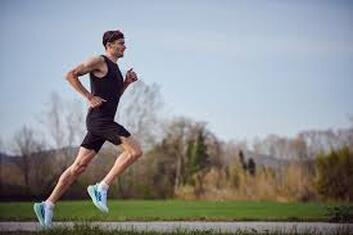
   In Tuesday's blog post we focused on the importance of arm drive. An arm drive in which the elbow drives backward and when coming forward travels in a path that would result in the index finger going up the nostril, can greatly improve efficiency.
   Posture - the word may sound boring, like your mother or choir director telling you to sit up straight. However in the quest to run faster, longer and with less effort, posture is critical. In great runners, as they drive or toe off,  we see a straight line through the ankle, knee, hip, shoulders and head. The body is in about a 5 degree forward lean and the eyes focus about 20 meters ahead. See photo below of Jan Frodeno - widely considered the best triathlete in the world.   
   Just looking ahead 20 meters will help greatly improve flow! Another tip which I use, and people report works well, is as follows: Imagine you have a string attached into your sternum. As you run, this string is continuously being pulled up and forward at a 45 degree angle by God or whatever you imagine. This lifts the chest off the ribs so you can breath and helps with foot strike position, which we will discuss in the next blog.
   Happy training
Picture
1 Comment

Welcome- Run Efficiency tip #1

4/20/2021

1 Comment

 
Welcome to Coach Dwight's blog. My goal is to provide athletes with common sense training tips and help them separate information from knowledge.
   I have spend many decades teaching runners to move at a faster pace with less effort. ( efficiency) In the past several years there have been many articles published promoting the idea that an athletes' natural run form is what nature created and coaching to improve this is a waste of time and effort.
   Would you apply this same thought process to an athletes' swim stroke? How about typing? There is a reason my mother can still type 60 plus words a minute. It's called efficiency - practiced proper technique.
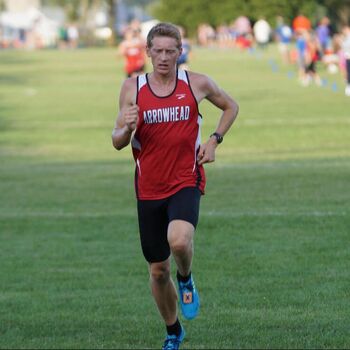
   Your arm and torso motion plays an important role in run efficiency. The elbow should drive backward as if it is driving nails into a wall behind you. (Elbow angle should be about 90 degrees) This puts a stretch on the pec muscle and thus the arm pops forward. When it does it should travel at an angle that if continued would result in your index finger going up your nostril! This arm drive pattern and angle should naturally encourage a small rotation of the upper back/shoulders which helps in the athletes' efforts to create "flow." Hips do not rotate along with the upper back.
   Next time you head out for your run make it a goal to improve your arm drive and torso rotation. It will show up in improved efficiency and assist greatly in maintaining speed at the end of races when your leg muscles are questioning your sanity!
   Happy Training
   Coach Dwight
Picture
1 Comment

    Author

    Dwight Sandvold is the Owner of Fitness and Sports Training SC. He has dedicated the past 35 years of his career and life to the Coaching and Sports Medicine fields. A veteran of over 180 triathlons he has qualified for Kona three times and Boston 4. Dwight and Janet have been married 36 years and have 3 boys all of which participated in Division 1 college athletics. 

    Archives

    August 2025
    July 2025
    June 2021
    May 2021
    April 2021

    Categories

    All

    RSS Feed

      Sign up to receive blog updates via email! 

    Subscribe to Newsletter

Location

Customer Testimonial: 
"Dwight does a fantastic job of training individuals. He has a lot of personal experience and professional experience, which allows him to bring a unique skillset to each session. He is very easy to talk to and I learn something every time I have a personal training session with him. Highly recommend for the triathlete or anyone looking to up their endurance/sports training."

Contact Us

    Subscribe Today!

Submit
© Fitness and Sports Training of Wisconsin LLC
  • Home
  • Triathlon Coaching
  • Performance Training
  • Contact
  • Personal Training
  • Men's Strength Training
  • Women's Strength Training
  • FAST Pictures
  • FAST Blog